Project #4 “Networking Memo Reflection”

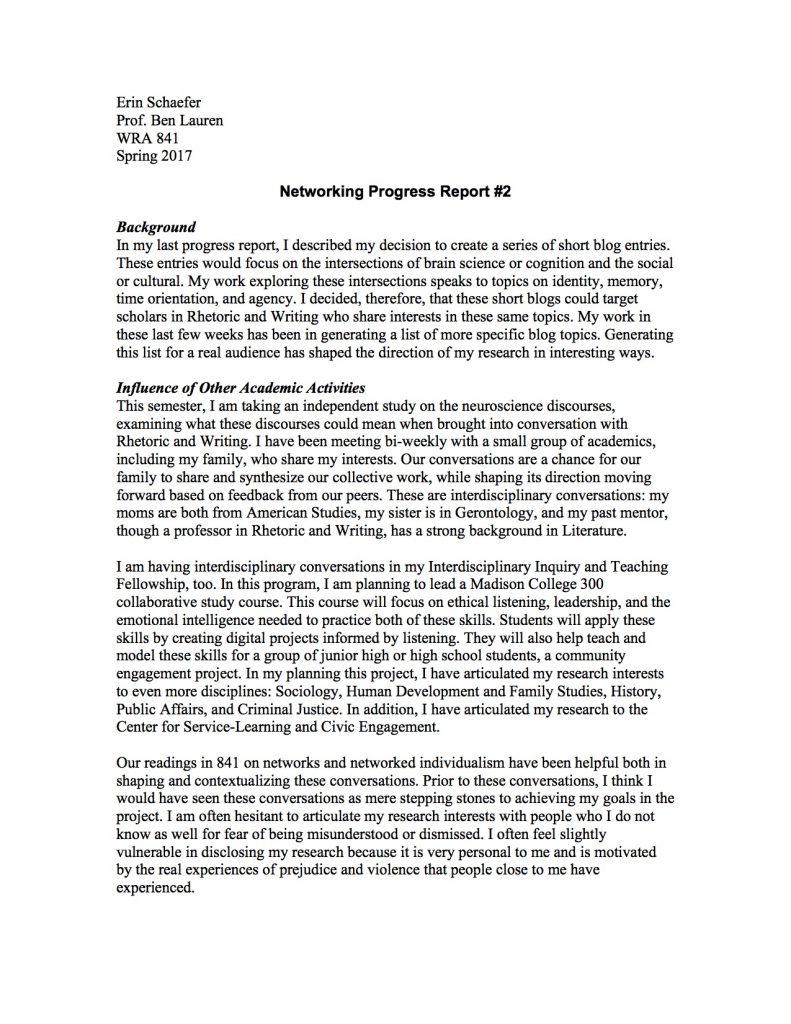
In this networking progress report (see embedded report below), I connected my existing projects (and their associated networks of people) to the concept of the “new social operating system of networked individualism” that we explored in WRA 841 (Rainie and Wellman, 2012, p. 3). Networked individualism refers to ways that individuals are becoming increasingly (need to be) networked, and it is considered an  “‘operating system’ because it describes the ways in which people connect, communicate, and exchange information” (2012, p. 7). Networks revolve around common interests and are facilitated to achieve common goals (2012).
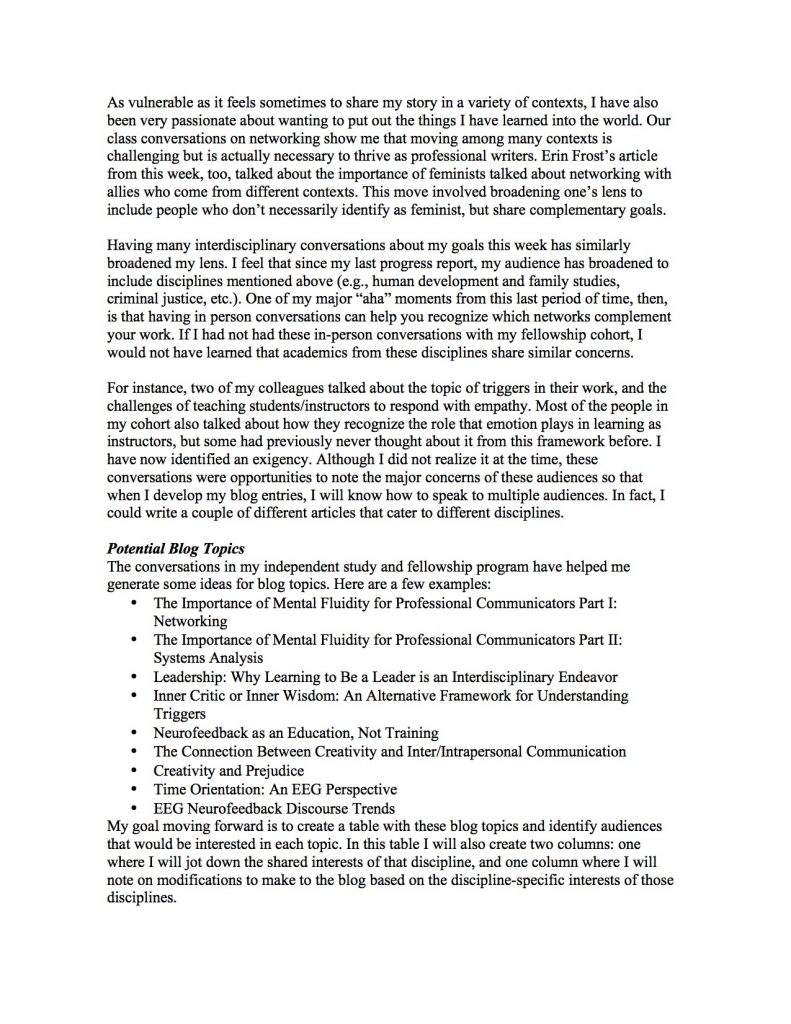
As vulnerable as it feels sometimes to share my story in a variety of contexts, I have also been very passionate about wanting to put out the things I have learned into the world. Our class conversations on networking show me that moving among many contexts is challenging but is actually necessary to thrive as professional writers. Erin Frost’s article from this week, too, talked about the importance of feminists talked about networking with allies who come from different contexts. This move involved broadening one’s lens to include people who don’t necessarily identify as feminist, but share complementary goals. 

Having many interdisciplinary conversations about my goals this week has similarly broadened my lens. I feel that since my last progress report, my audience has broadened to include disciplines mentioned above (e.g., human development and family studies, criminal justice, etc.). One of my major “aha” moments from this last period of time, then, is that having in person conversations can help you recognize which networks complement your work. If I had not had these in-person conversations with my fellowship cohort, I would not have learned that academics from these disciplines share similar concerns. 

For instance, two of my colleagues talked about the topic of triggers in their work, and the challenges of teaching students/instructors to respond with empathy. Most of the people in my cohort also talked about how they recognize the role that emotion plays in learning as instructors, but some had previously never thought about it from this framework before. I have now identified an exigency. Although I did not realize it at the time, these conversations were opportunities to note the major concerns of these audiences so that when I develop my blog entries, I will know how to speak to multiple audiences. In fact, I could write a couple of different articles that cater to different disciplines. 

Potential Blog Topics  
The conversations in my independent study and fellowship program have helped me generate some ideas for blog topics. Here are a few examples:
•	The Importance of Mental Fluidity for Professional Communicators Part I: Networking
•	The Importance of Mental Fluidity for Professional Communicators Part II: Systems Analysis
•	Leadership: Why Learning to Be a Leader is an Interdisciplinary Endeavor
•	Inner Critic or Inner Wisdom: An Alternative Framework for Understanding Triggers
•	Neurofeedback as an Education, Not Training
•	The Connection Between Creativity and Inter/Intrapersonal Communication
•	Creativity and Prejudice
•	Time Orientation: An EEG Perspective  
•	EEG Neurofeedback Discourse Trends
My goal moving forward is to create a table with these blog topics and identify audiences that would be interested in each topic. In this table I will also create two columns: one where I will jot down the shared interests of that discipline, and one column where I will note on modifications to make to the blog based on the discipline-specific interests of those disciplines.

In this memo, I reflect on my networks: what they are and how I am connected to them. In the process, I recognized that as an interdisciplinary scholar, I am connected to many networks. Although I am somewhat concerned about the risks involved in sharing and connecting my work with others, I have concluded that my personal investment in this work outweighs the fear associated with collaboration. Considering how I want to relate to my networks was a very important move for me, and one that helped me generate a list of potential conversations that I could start (as well as people who might participate in these conversations).

Since this memo,I’ve come to focus on developing networks of individuals interested in listening practices. This semester (Fall 2018), I have had conversations with people interested in providing video interviews on their listening practices,including two musicians, several game developers (focused on empathy), the parent of a neurodiverse child, and a gerontologist. This early reflection on the nature of networks has also informed my work practices in general this semester.

The activity from WRA 841 has allowed me to more clearly identify areas of mutual interest between groups, and then to propose relationships among them. For instance,when working with the Collaborating for Change Learning Community (comprised of marginalized and underrepresented teaching assistants and allies), I recognized their need to generate conversations about pedagogy, and proposed that they connect with the similar interests of the iTeachMSU digital commons development meetings. Recognizing the importance of collaboration that I learned fromProject #3 (Interview: “Communication for Change”), I am also facilitating a focus group that is identifying what a site devoted to the Communication forChange learning community might do, and how this site might interact with the iTeachMSU digital commons, something that’s requiring me to mediate between networks. I’m learning to recognize and involve relevant networks in the design of projects at every phase, something that is also informing my teaching, as I am currently teaching WRA 210: Introduction to Web Authoring.

css.php