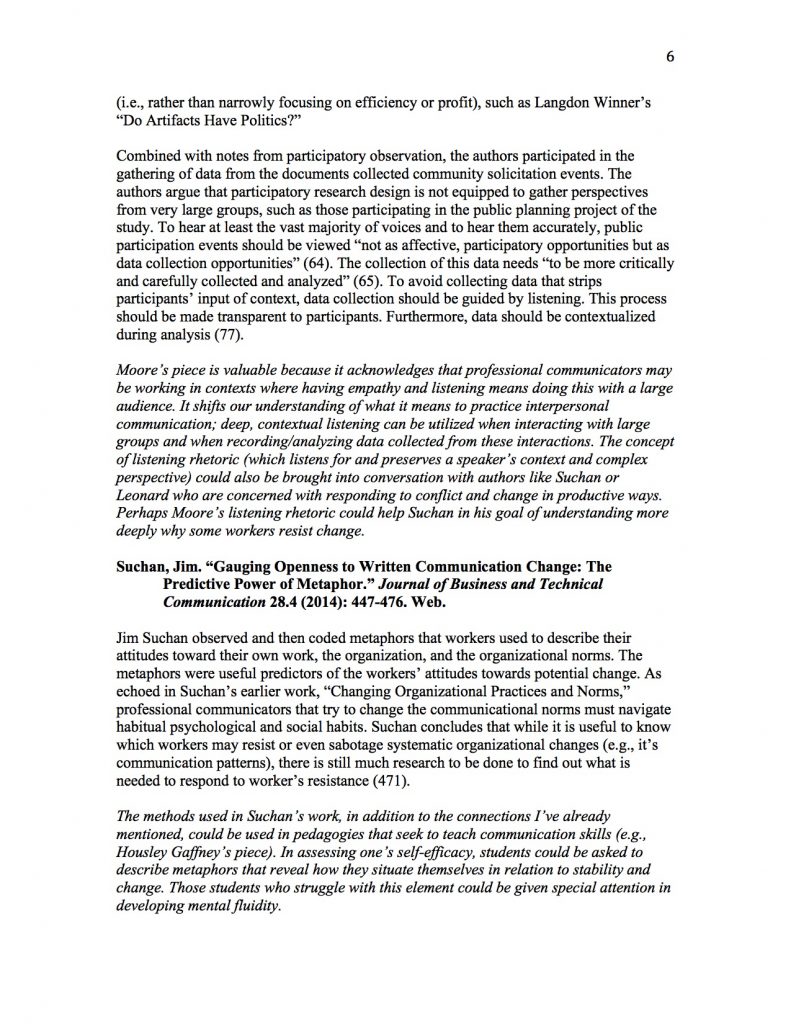
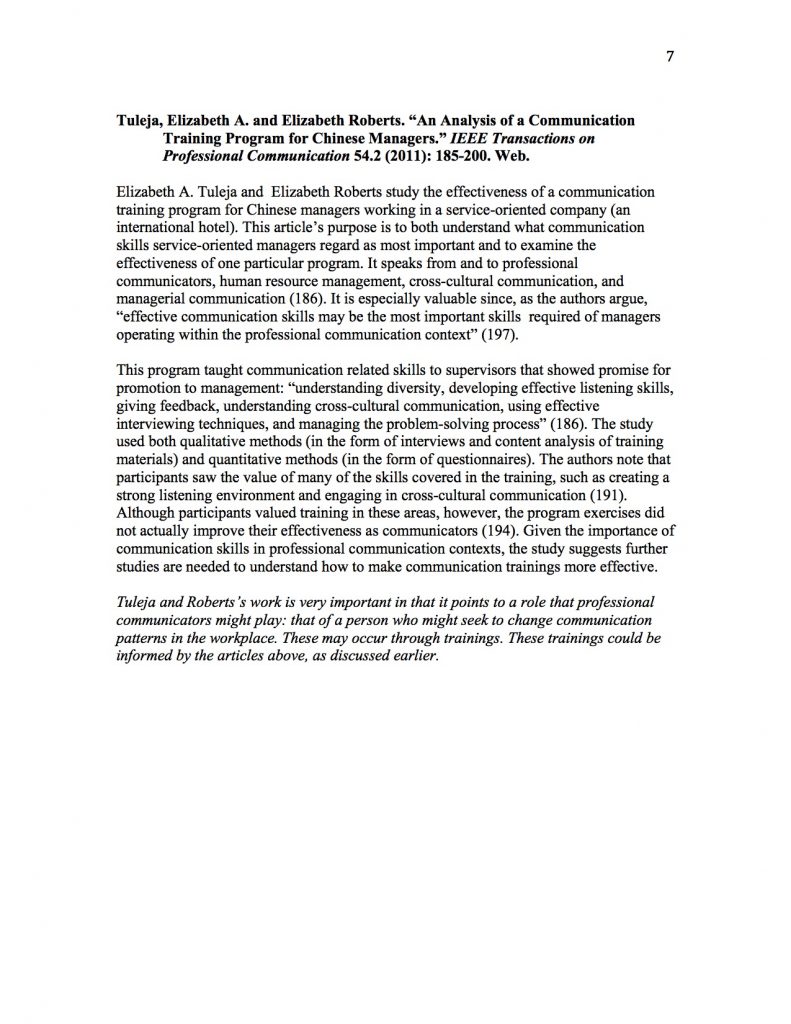
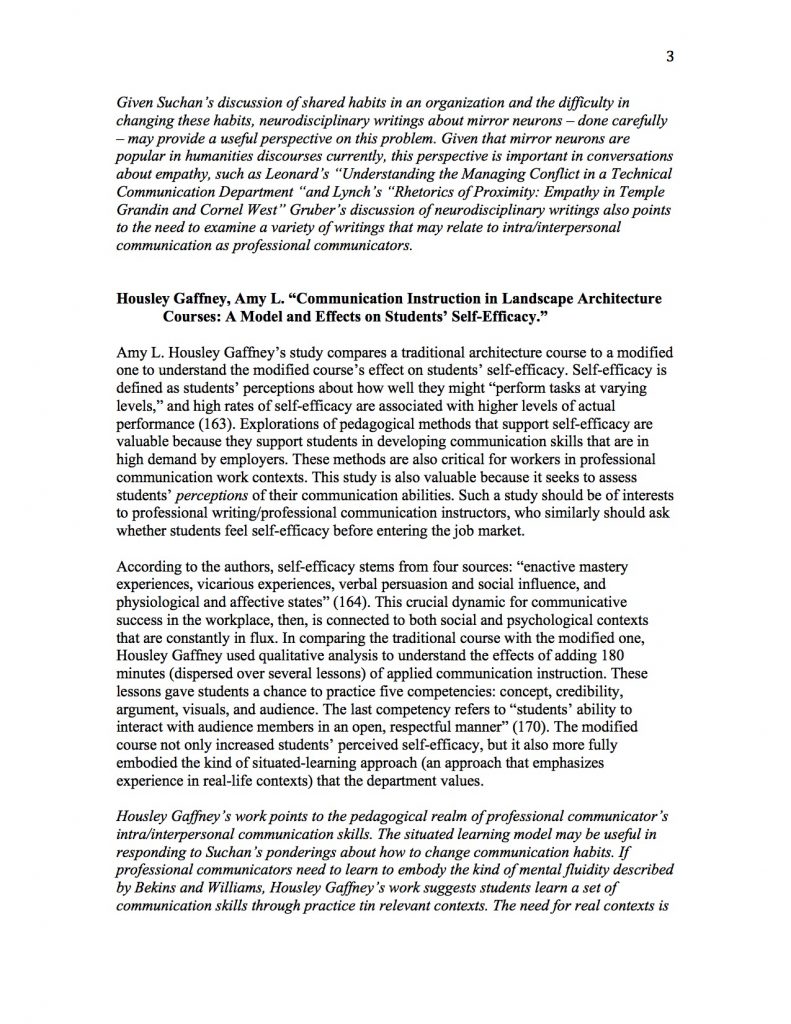
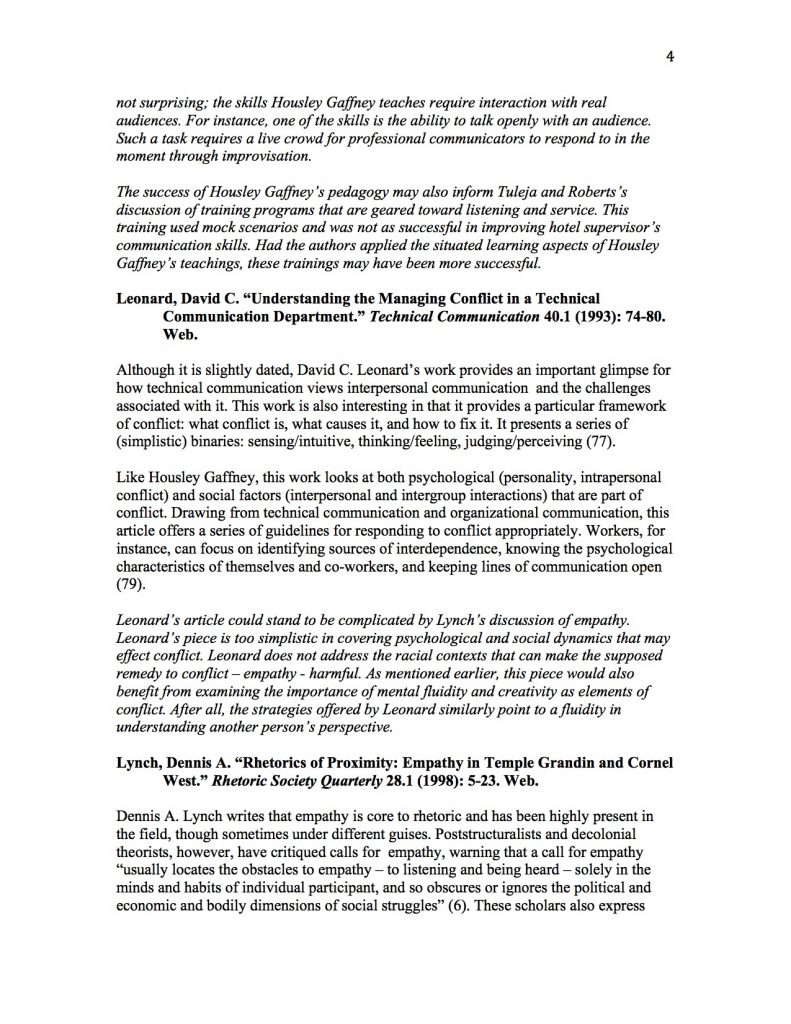
I constructed the annotated bibliography below in WRA 841: Professional Writing Theory andResearch as the beginning annotated bibliography for my concentration exam. I include it here to demonstrate how much my understanding of listening inProfessional Writing and Technical Communication has grown since then. For instance, this annotated bibliography does not include scholarship on community engagement projects. At the time that I created this early bibliography, I had not yet reflected on and integrated the understanding gained from my interview with Leslie (see Project #3). I have also been able to take advantage of the time between the conclusion of my concentration coursework and the completing of this essay to reflect on the Professional Writing and Technical Communication’s treatment of listening in several contexts (e.g., in working with the GEUPedagogy Committee, iTeachMSU Commons, and the Collaborating for ChangeLearning Community).
![Erin Schaefer
WRA 841
Professor Ben Lauren
Wednesday, February 22, 2017
Annotated Bibliography
Bekins, Linn K. and Sean D. Williams. “Positioning Technical Communication for the Creative Economy.” Technical Communication 53.3 (2006): 287-295. Web.
Linn K. Bekins and Sean D. Williams work is useful for existing and emerging technical communicators who seek to understand/construct their identity in the current economy. It outlines the critical skills necessary to succeed in a creative economy, one that centered on “‘high skills’ that include creativity, ability to navigate ambiguity, comfort with multiplicity and complexity, interpersonal understanding and empathy, synthesis, pattern recognition, and the ability to tell good stories” (289). Bekins and Williams argue that the field of technical communication needs a new curriculum that responds to the creativity economy, if the field and its members are to thrive.
While the authors acknowledge that their work challenges some of the (288), their suggested curriculum nods to and builds from past core technical communication principles. They suggest three core elements of a new curriculum: “1. Teach the rhetorical tradition to build SMEs [subject matter experts] 2. Provide broad experiential learning opportunities to build managers 3. Create a culture of continuous learning to build leaders” (289). Numbers two and three of this curriculum emphasize the importance of gaining diverse experiences that will allow technical communicators to respond to ever changing organizational contexts, responding to these changes with an entrepreneurial spirit of innovation and leadership. Instructors of professional writing must work hard to integrate these “‘real world’ writing situations” for students, while also emphasizing the importance of articulating the deep ways that technical communicators can transform an organization.
This work is important given more recent literature on the networked nature of society, such as Lee Rainie and Barry Wellman’s Networked: The New Social Operating System which emphasizes the importance of orchestrating complex webs of relationships. Bekin and Williams complements the works of Clasy Spinuzzi’s “Technical Communication in the Age of Distributed Work” and Stacey Pigg’s “Coordinating Constant Invention: Social Media’s Role in Distributed Work,” for instance, which emphasize the polycontextual nature of technical communication work. Bekins and Williams have a somewhat unique focuses on empathy. They write, for instance, that “Rhetorical analysis and collaborating with others are ‘high concept’ skills that require empathy” and that “the ability to have empathy, to design, to tell a good story are all key aspects of the creative class” (290-1). Their work connects with others who have examined the difficulty in navigating difficult emotions and fixed habits of mind, such as Jim Suchan’s “Changing](https://erinschaefer.net/wp-content/uploads/2018/12/Annotated-Bibliography-1-791x1024.jpg)

![concerns about the uneven playing field: marginalized groups often end up listening to already privileged voices, while those with privilege show little to no interest in listening to marginalized voices (9). Privileged voices who do desire to hear marginalized voices can do even worse harm; they can end up displacing the body of a marginalized person and/or assuming that they can fully grasp what it’s like to be in a marginalized person’s shoes.
Lynch offers the work of Temple Grandin and Cornel West as examples of calls to empathy that do not deny these dimensions of marginalized people’s struggle to be heard. Grandin’s work simultaneously invites empathy and discourages comfort or confidence in that empathy. This text models how a person can engage in empathy without assuming that he/she is really in another person’s shoes (11). West’s speech (and book) similarly addresses this assumption but through a different method: asking the reader to continually question the location of their own selves and bodies. It asks us “to look back towards ourselves, to our sense of our selves and our own bodies, and to how we believe we inhabit the social and bodily spaces we claim as our own” (14). West’s work, far from ignoring difficulties that marginalized voices have in being heard, discusses the erasure of black bodies throughout history (16). West also strategically asks white people to displace their own bodies, describing this strategy as such: “if I am to move towards another, without displacing that other, I must displace myself” (18).
Lynche’s work is important for any organization that cites the importance of empathy for professional communicators (i.e., Bekins and Williams; Leonard; and Moore and Elliott). Other authors have not even nodded to these issues, and yet ignoring the potentially harmful effects of empathy can be very damaging (especially for community work).
Moore, Kristen R. and Timothy J. Elliott. “From Participatory Design to a Listening Infrastructure: A Case of Urban Planning and Participation.” Journal of Business and Technical Communication 59-84 (2016): 59-84. Web.
Technical communicators are often faced with the task of designing materials or working on projects ¬that should respond to a large number of community members’ desires. Kristin R. Moore and Timothy J. Elliott propose that to do these kinds of projects effectively, technical communicators should draw from tacit knowledge – knowledge from doing – produced by conversations with participants (in this case, members of the community) (61). Unless these conversations are guided by a rhetoric of listening, however, the perspectives of participants gathered in “design charrettes, workshops, and open houses” will not translate into the final projects.
This article should be of value, therefore, to those working in governmental agencies where soliciting community participation is required, but also to those in a variety of professional writing organizational contexts (e.g., non-profit outreach committee meeting or a marketing focus group for a company). It is useful in offering practical steps to avoid silencing already marginalized groups of citizens while “support[ing] the views of only a few powerful decision makers” (62). This work may also answer calls from authors who have argued that designers need to be more socially aware and responsible](https://erinschaefer.net/wp-content/uploads/2018/12/Annotated-Bibliography-5-791x1024.jpg)